Tuesday, December 27, 2022

DOST S&T Fellows Program Invites you to Watch the Second Episode of S&T Features: A Spotlight on 3D Printing

Taguig City – After its pilot episode on October showcasing mental health, the second episode of S&T Features will now put a spotlight on the 3D Printing industry in the Philippines on 28 December 2022, 10 AM via Facebook Live of the DOST S&T Fellows Program.

The S&T Features is an online show which aims to promote the S&T Fellows Program by showcasing the accomplishments and involvements of the S&T Fellows in their respective DOST agencies. For this episode, it will highlight the engagement of Dr. Mark Christian Manuel, an S&T Fellow assigned to the Metals Industry Research and Development Center (DOST-MIRDC), in the Advanced Manufacturing Center, the country’s state-of-the-art hub on additive manufacturing.

“Our goal in the S&T Fellows Program is to engage the skills and expertise of our Filipino researchers, scientists, and engineers to undertake research and development in the various agencies of DOST, and I am glad that we have one that can steer the path in the growing industry of 3D Printing in the country,” said Undersecretary for Research and Development, Dr. Leah J. Buendia. 

“The 3D Printing industry in the Philippines is making a rise and is expected to have significant impact on various industries such as healthcare, aerospace, automotive, architecture, construction, among others. I want to see the Philippines to be at par with other countries when it comes to 3D Printing and my contribution as an S&T Fellow particularly with AMCen provides an opportunity for me to make that dream a reality,” expressed Dr. Manuel.

To further discuss AMCen’s numerous engagements and works with stakeholders and partners, Dr. Manuel will be joined by Engr. Joseph Alfred Garcia, Officer-in-Charge-Supervising Science Research Specialist, Materials and Process Research Division at the DOST-MIRC and Mr. Voltz Gaviola, Marketing Manager at the Makerlabs Electronics, one of the AMCen’s industry partners.

To watch the second episode of  S&T Features, kindly visit this link: https://tinyurl.com/STFeatureEpisode2 and click “Going” to be notified when we go live. 

To know more about the DOST S&T Fellows Program, please follow our Facebook page: https://www.facebook.com/DOST.STFellows. For inquiries, you may send us a message via email at sntfellows@dost.gov.ph 

DOST Balik Scientist Discovers Alternative Cooking Fuel to Replace LPG Stoves in Homes

The Department of Science and Technology (DOST) - Balik Scientist hosted by the Mariano Marcos State University (MMSU) in Laoag, Ilocos Norte is set to provide clean cooking fuel alternatives to Filipino homes.  

Dr. Fiorello B. Abenes, a Professor Emeritus in CalPoly Pomona University in California, USA and a Balik Scientist hosted by MMSU leads the technology transfer and commercialization of MMSU’s Village-Scale Nipahol Technology (VSNT). Nipahol Technology may also be used as cooking fuel and is seen to replace Liquified Petroleum Gas (LPG) stoves.  

“Dirty cooking is still a problem in many of the rural areas of the Philippines. The use of firewood or charcoal emit unhealthy levels of particulates and noxious gases that affect the respiratory track, mostly affecting women. Ethanol as cooking fuel is cleaner,” says Dr. Abenes. “We have developed a prototype that we hope we can scale up and make into a cooking stove suitable for indoor use and in commercial establishments.”

Although the stove prototype is yet to be developed as pressurized, Dr. Abenes and his team at MMSU successfully created a nipahol-fueled stove with burner and functions through the pull of gravity.  The successful adoption of MMSU’s VSNT rests on finding more uses for the ethanol produced from NIPA. The use of Nipahol as cooking fuel will accelerate the commercialization of the VSNT technology. 


Nipahol Technology are the innovations produced from extracting sap from Nipa (Nypa fruticans) into "Nipahol" at a facility housed at the National Bioenergy Research and Innovation Center (NBERIC) of the MMSU. Technologies from Nipa is seen to provide a multitude of uses, given its commercial viability in different portions of the value chain.  

The Balik Scientist Program aims to promote information exchange and accelerate the flow of new technology into the country through strengthening the scientific and technological manpower of the academe and public and private institutions. The Program encourages Filipino scientists, technologists, and experts to return to the Philippines and share their expertise in order to promote scientific, agro-industrial, and economic development, including the development of the country's human capital in science, technology, and innovation.  
 
The enactment of the Balik Scientist Act in June 2018 also paved the way for DOST to grant returning Filipino scientists with competitive benefits such as daily subsistence allowance, health insurance, and roundtrip airfare.  For those interested to become a Balik Scientist, you may contact the DOST Balik Scientist Program Management Office thru email at bsp@dost.gov.ph.  

Monday, December 26, 2022

CONCEPCION PUSHES AGRI-MICROENTREPRENEURSHIP FOR JOB GENERATION

President Ferdinand Marcos Jr. met with the Private Sector Advisory Council led by Aboitiz Group CEO Sabin Aboitiz and the lead for the Jobs sector, Go Negosyo founder Joey Concepcion last Dec. 9 to address job generation in the country.Among the proposals presented by the group were the scaling-up of MSMEs to help generate more jobs, prioritizing the upskilling of workers, and ensuring that the Philippines is prepared to receive local and international investments. 

Concepcion emphasized in particular the importance of helping agri-microentrepreneurs, which he said will also address problems in food security. Concepcion noted how MSMEsprovide more than 62 percent to jobs in the Philippines. Helping grow microentrepreneurs in the agriculture sector is a more challenging task than in the retail sector, he said, and to scale them up will need the participation of large companies.

Concepcion cited Lionheart Farms as an example of a large company successfully helping smaller farmers. The Palawan-based company specializes in organic farming and strives to do all its business locally. Its CEO and Co-founder Christian Moeller presented to the group the concept behind the farm, which is similar to nucleus estate farming. This is a form of contract farming where big companies provide the large initial investments and resources necessary for a farm to profitably operate, and small farmers or cooperatives enter into contract agreements with the larger companies. Lionheart Farms reports that opportunities for entrepreneurship and businesses have risen significantly in the Municipality of Rizal, where it is based, and opened up opportunities for several other small businesses in the area. After only a few years of operation, it has become one of  the largest employers in Palawan.

Aside from Lionheart Farms, other large companies have also realized the benefit of including in their value chain the small companies that support their operations. Among these are Universal Leaf Phils., Bounty Fresh Food, NestlĂ©, and SL Agritech.

Concepcion said he plans to focus on agri-microentrepreneurs the Kapatid Angat Lahat  (KAL) program, which was first started in 2016 as a way to encourage medium and large corporations to help micro and small enterprises by including them in their value chain.

“We are not talking here of doleouts, but of a sustainable and inclusive way where both parties can benefit and prosper,” Concepcion explained in an earlier statement. “Kapatid Angat Lahat will give access to the farmers a business model that will have mentoring, and access to money and markets,” he said. 

“This is being done now; we need only to scale it up,” he said.

He also emphasized the importance of local government. “With the right leadership at the local level, the chances for success are higher. They will also help us pinpoint which LGUs are ready for this,” said Concepcion. Former Department of Agriculture Sec. William Dar will join the KAL as an adviser to its agriculture program. Also being tapped for KAL are Dept. of Local and Interior Government Sec. Benhur Abalos and Piddig, Ilocos Norte Mayor Eddie Guillen. “Mayor Guillen has done it in his town with Universal Leaf Phils. Working together with its president, Winston Uy, they turned around the tobacco industry in that area and made it a leading exporter of tobacco,” he said.

Concepcion said the KAL program can pave the way for a Food Security Council, whose mission will be to ensure food security for the country. “For now we will do our best to make this work,” he said. “The confidence is high because large agri-entrepreneurs and local government will be behind this program,with the President’s blessing,” he said.

FORMER DA SEC. WILLIAM DAR JOINS GO NEGOSYO’S KAPATID ANGAT LAHAT PROGRAM

Former Department of Agriculture Secretary William Dar has joined Go Negosyo’s Kapatid Angat Lahat as Head of its Agriculture program. Kapatid Angat Lahat aims to encourage medium and large corporations to help micro and small enterprises by including them in their value chain.
 
“When we first introduced Kapatid Angat Lahat in 2016, we saw that for MSMEs to grow and evolve from micro to small, small to medium, and medium to large, they need the three M’s of money, market and mentoring, which can come with the help of big-brother corporations,” said Go Negosyo founder Joey Concepcion. Last August 26 at the 2022 MSME Summit, a total of 37 organizations committed to its ideals and signed a pledge which was later presented to President Ferdinand Marcos Jr.
 
Mr. Dar served as Secretary of Agriculture under former President Rodrigo Duterte. He was also the first director of the Philippine Bureau of Agricultural Research, and served as an executive director of the Philippine Council for Agriculture, Aquatic, and Natural Resources Research and Development.
 
Along with Dar, Kapatid Angat Lahat will also be guided by inputs from the Department of Local and Interior Government Sec. Benhur Abalos. “The experience and expertise of former Sec. Dar and Sec. Abalos will be of great help in finding solutions to how we can uplift our micro-farmers,” Concepcion said. The Go Negosyo founder recently presided over a meeting that brought together former Sec. Dar, National Irrigation Administration chief and former Piddig Mayor Eddie Guillen, Universal Leaf Phils. (ULP) President Winston Uy, and Lionheart Farms CEO and Co-Founder Christian Eyde Moeller. Another meeting is set for January to tackle the role of local government units in encouraging agri-microentrepreneurship.
 
“I would like to believe that there are existing models to improve upon,” Dar remarked, with reference to the success of models adopted by ULP and Lionheart. “Now, with  the coming in of Go Negosyo through the Kapatid Angat Lahat program for agro-microentrepreneurship, we need to elevate these models by way of looking at them through a number of lenses,” he said. Among these lenses are productivity, value chain analysis, sustainability, resiliency and inclusivity.
 
“Private sector cannot do it alone,” said Concepcion. “It needs to work with the LGUs and their leadership. Together we must provide an enabling environment that can help our country’s micro-farmers grow and become entrepreneurs,” said Concepcion. Among the first approaches would be to focus on four key crops, namely rice, coconut, corn and tobacco.
 
Concepcion cited the experience of Guillen in working with ULP and turning the province’s moribund tobacco industry into an exporting powerhouse by examining the industry’s value chain and the socio-economic structures surrounding it. In Palawan, Lionheart Farms is being cited as an example of how a large company can help small farmers using a system similar to nucleus estate farming, where small farmers or cooperatives enter into contract agreements with big companies, who provide the large initial investments and resources necessary for a farm to profitably operate. “Christian Moeller has a fantastic model that can help our micro-farmers,” observed Concepcion.
 
Uplifting the country’s agriculture sector is seen as especially crucial to job generation, a key priority of the Marcos administration and the jobs sector led by Concepcion as a member of the Private Sector Advisory Council.
 
“More than 62 percent of the jobs generated in the Philippines come from MSMEs, and a big part of these MSMEs come from the agriculture sector,” said Concepcion. He explained that the most challenged among these MSMEs are in the agriculture sector, most especially those operating at the smallest scale, or the micro-farmers. “We will aim to scale up our micro-farmers so they can become entrepreneurs, help them grow from micro to small, small to medium, and in the process, create more jobs for Filipinos, especially in the countryside,” he said.
 
Beyond agriculture, Kapatid Angat Lahat will also have programs that will cover other sectors, including retail, where many micro-entrepreneurs can be found.
 

MASHAV Israel Sponsors Repair Materials of Typhoon Paeng-Stricken Familiesin Marinduque

The Embassy of Israel, through its Agency for International Development Cooperation (MASHAV), in partnership with Caritas Philippines and the Diocese of Boac, sponsored shelter repair kits to aid the families affected by Typhoon Paeng, which devastated the island province of Marinduque last October 29, 2022.

Israeli Ambassador Ilan Fluss, together with his wife Gila, personally visited Marinduque on December 7 and 8 to visit the recipients in the barangays of Cawit, Tabigue, and Laylay in Boac, Marinduque. Fifty-three (53) families affected by Typhoon Paeng in the said province benefited from the Israeli Embassy's emergency response assistance.

“This is the first time we have a partnership between the Embassy and Caritas - a very symbolic partnership between the Jewish State of Israel and the Catholic Church of the Philippines,” Ambassador Ilan Fluss said.

Sunday, December 25, 2022

Macau Eliminates Quarantine, Changes to Yellw code+RAT policy

Macau has eliminated quarantine for all people entering the territory, ending a years-long policy which has tanked the city’s economy and put massive pressure on gaming operators.

Starting from today, those entering the territory from anywhere except mainland China will be given a Yellow health code for five days, but will not be subject to any type of quarantine.

The Yellow code allows for entry into almost all of Macau’s venues, except certain public facilities.

The measure comes less than a week after Macau implemented home quarantine for arrivals from outside China who could prove residency in Macau. The move was welcomed by locals but operators called for a full elimination of quarantine and easing of testing requirements for mainland Chinese visitors in order to actually boost the economy.

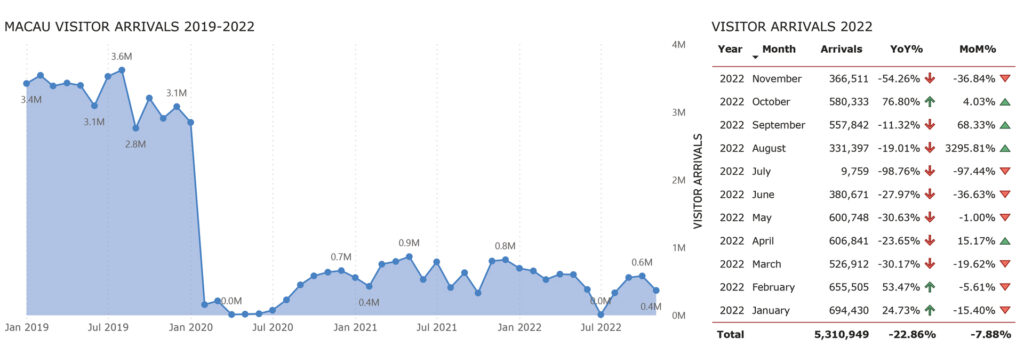
MACAU-VISITOR-ARRIVALS, November 2022

During the five-day period of Yellow code, entrants are required to conduct daily rapid antigen tests and upload them to Macau’s health code. If all results are negative, the code changes to Green. If the result is positive, home isolation will be required.

Despite the change, anyone arriving to Macau by plane, boat or other vehicle will be required to present a negative nucleic acid test result taken within 72 hours of departure, before departing.

Entrants will no longer be required to take a nucleic acid test at the borders and the previously mandated NAT on the third day after arrival has been canceled.

All entrants to Macau will be allowed to depart immediately to Hong Kong, Taiwan or other foreign countries, but must stay eight days in Macau before entering mainland China.

Reversal and revival

Macau’s entry rquirement change comes amongst a large wave of infections in the SAR, with the government previously predicting that up to 80 percent of the population could become infected.

Daily cases average between 80 and 100, a figure which would have previously placed the entire city under lockdown and resulted in the likely closure of the SAR’s casinos.

Under the current wave, the city’s Health Bureau director said that expectations are for the peak to be reached within one to two weeks.

The estimate could bode well for visitation during Chinese New Year, one of Macau’s peak Golden Week periods, giving a strong boost to January GGR, as the holiday falls during the month.

It could also give a much-needed impetus to the gaming concessionaires in the first month of their new gaming concessions, which come into effect on January 1st

Balik Scientist Program & National Council for Health Research & Development

During the past two (2) decades, the brain drain has worsened in the Philippines. In an effort to counter this phenomenon and to capitalize on the Filipino emigrants’ expertise, the Balik Scientist Program (BSP), through the Presidential Decree 819, was established in October 1975.   It was revitalized in 2007, with the necessary policies and funding support.

The Balik Scientist Program (BSP) aims to promote information exchange and accelerate the flow of new technology into the country through strengthening the scientific and technological manpower of the academe and public and private institutions. The program’s objective is to encourage Filipino scientists and technologists to return and reside in the Philippines and share their expertise for the development of the country.

The transfer of the Balik-Scientist Program (BSP)  from the DOST Central Office to the three sectoral councils of DOST in May 2013 aims to strengthen, institutionalize and give more focus on each of the Council’s priority programs. The Philippine Council for Health Research and Development (PCHRD) focuses on evaluating BSP Applicants for the health R&D sector.  This move aims to strengthen  the implementation of the priority programs identified in the DOST-PCHRD’s National Unified Health Research Agenda (NUHRA) for the health R&D sector through the provision of expertise by the Balik Scientists.

For the past six (6) years (2007 to present), there were a total of approximately thirty-eight (38) BSP awardees in the health sector.
  
The Philippine Council for Health Research and Development (PCHRD) is one of the three sectoral councils of the Department of Science and Technology (DOST). It is a forward-looking, partnership-based national body responsible for coordinating and monitoring health research activities in the country.